



Tank Manufacturer for Data Centers
Custom Chilled Water Storage, Buffer, Expansion, and Glycol Tanks for Mission-Critical Data Centers
Data center cooling infrastructure must perform with absolute reliability under rapidly changing, high-density loads driven by AI workloads, hyperscale expansion, and increasing rack power densities. The systems behind that cooling must be engineered for long-term performance, stability, and predictable operation. Thermal Energy Storage (TES) Tanks, chilled water storage tanks, buffer tanks, expansion tanks are all critical components in data center cooling systems.
Tate Metalworks collaborates with mechanical engineers, EPC firms, and facility operators to deliver precision-built thermal storage and fluid management solutions aligned with complex load profiles, phased construction schedules, and strict uptime requirements.
In facilities where thermal energy storage (TES) is deployed, a chilled water storage tank stores thermal energy in the form of chilled water for later use within the cooling system. This allows operators to supplement cooling capacity during peak demand, phased commissioning, utility events, or equipment transitions.
Our custom tanks support these objectives by storing thermal energy where applicable, stabilizing loop performance, and protecting equipment from pressure fluctuations—helping maintain resilient, reliable cooling operations.
Request A Data Center Tank Proposal
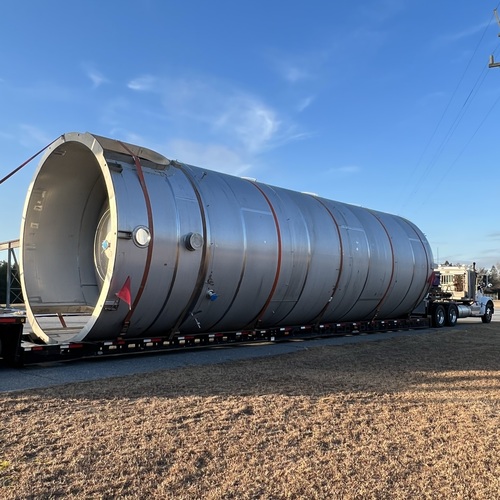
Data Center Tank Types and Their Roles
Different cooling architectures call for different tank functions. Common tank types in data center applications include:
- Chilled Water Storage Tanks (TES): Store thermal energy for later use, enabling load shifting, contingency support, or phased commissioning in systems designed for thermal storage.
- Buffer Tanks: Increase system volume, reduce short cycling, and stabilize temperature and flow in variable-load chilled water systems.
- Expansion Tanks: Absorb thermal expansion and maintain proper pressure as water temperature changes throughout closed-loop systems.
Why Data Centers Use Chilled Water Storage and Buffer Tanks
Traditional cooling systems operate in real time, generating chilled water as demand occurs. In contrast, chilled water storage systems allow facilities to produce and store thermal energy during off-peak periods and deploy it when needed.
Buffer tanks play a complementary role by stabilizing system volume and improving control in variable-load environments. In some data center cooling plants, both tank types are used together to improve resilience and operational flexibility.
Key benefits may include:
- Additional cooling capacity: Properly sized TES systems can provide supplemental cooling ranging from minutes to multiple hours, depending on system design and load.
- Peak demand management: Shifting cooling production to off-peak windows can reduce electrical demand exposure in markets with time-of-use pricing or demand charges.
- System stability: Buffer tanks improve temperature control, reduce short cycling, and support efficient operation across changing server loads.
- Operational flexibility: Storage capacity can support phased commissioning and transitions between cooling equipment.
- Scalable design: Storage systems can often be expanded as campuses grow without requiring a full cooling plant redesign.
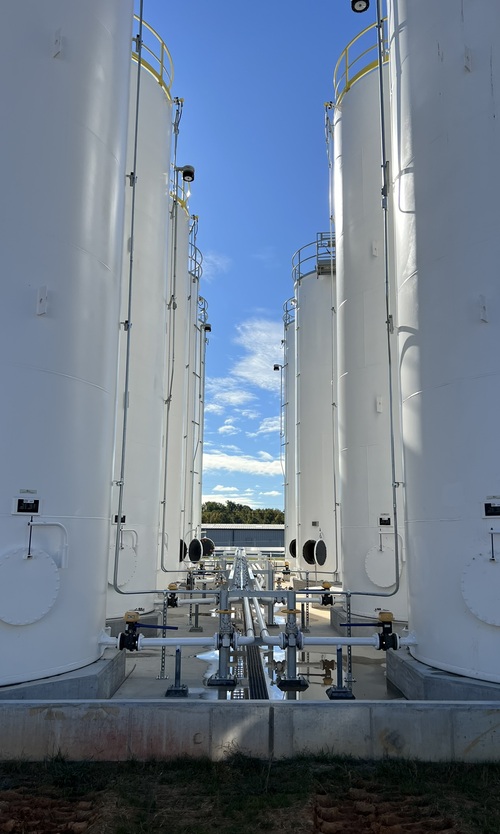
Tate Metalworks for Data Center Tanks You Can Rely On
With a fabrication facility in Roebuck, SC and field erected teams that service the United States we can handle multi-vessel projects to large field erected tanks built on site.
Our Capabilities include:
- 50,000 square foot assembly bay
- ASME “U” Stamp certified, welders certified to ASME Section IX.
- Metallurgy expertise: carbon steel, stainless, duplex, C276 and other specialty alloys
- State of the art burning, rolling and welding equipment.
- Onsite Non Destructive Examination with third party radiography
- Key strategic partners for sourcing heads and ASTM plate, delivering quality, material traceability at a competitive cost
- Transparent communication, trusted scheduling, and demand planning.
Our team works directly with engineers and contractors to develop tank configurations that align with site constraints, cooling load profiles, seismic requirements, and connection layouts. Whether the project calls for a shop-fabricated vessel or a large field-erected installation, we deliver consistent quality and execution.
From Hyperscale Campuses to Edge Facilities
Data center requirements vary widely based on scale and deployment model:
- Hyperscale campuses may require large field-erected storage tanks capable of holding hundreds of thousands of gallons.
- Colocation facilities often benefit from compact, shop-fabricated vessels designed for retrofit or constrained environments.
- Edge deployments demand efficient configurations that maximize capacity within limited footprints.
Our fabrication capabilities support both shop-built and field-erected tanks, with materials selected based on water chemistry, glycol concentration, and site conditions.
Supporting Phased Commissioning and Expansion
Data center projects are frequently built and commissioned in phases. Properly designed storage systems can help bridge cooling gaps during construction, allowing partial facility operation while additional infrastructure is brought online.
Tate Metalworks supports these scenarios with engineered tank solutions and coordinated fabrication schedules aligned with construction timelines.
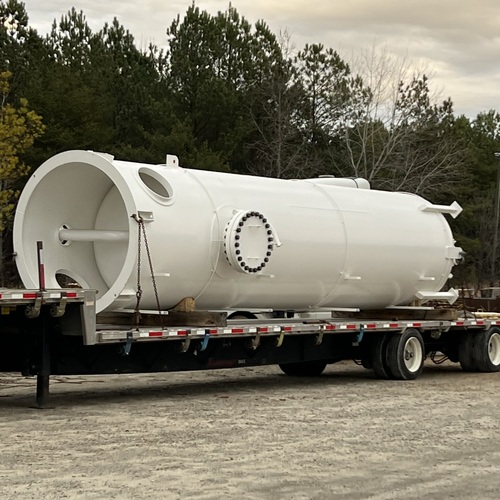
Common Data Center Tank Features
- Single-wall and double-wall construction options
- Interior coatings compatible with chilled water or glycol chemistry
- Exterior corrosion protection and insulation systems
- Custom nozzle configurations, manways, and instrumentation connections
- Engineered diffuser systems to maintain thermal stratification in TES applications
- Seismic and wind load design for outdoor installations
- Shop-fabricated or field-erected configurations based on site requirements
Why Tate Metalworks
Tate Metalworks combines ASME-certified fabrication, field erection capability, and engineering collaboration under one team—reducing coordination risk and improving schedule certainty for mission-critical cooling projects.
Our experience in thermal energy storage and large-scale industrial fabrication enables us to deliver tanks that meet the performance, durability, and timeline demands of modern data center infrastructure.
Ready to Discuss Your Data Center Cooling Project?
Our engineering team is ready to review your specifications and develop a custom solution aligned with your cooling loads, construction schedule, and budget. Submit your RFQ to receive a detailed proposal and next-step guidance.
Frequently Asked Questions
-
What codes and standards apply to these tanks?
Most chilled water, buffer, and expansion tanks are fabricated to ASME Section VIII, Division 1, with welders qualified under ASME Section IX and materials meeting ASTM specifications. Large atmospheric tanks less than 2.5 psi will be designed to API 650 and field erected on site.
-
What is the difference between a TES tank and a buffer tank?
A TES tank stores thermal energy for later use, while a buffer tank increases system volume and stabilizes temperature and flow.
-
What does an expansion tank do?
It absorbs fluid expansion due to temperature changes, maintaining stable pressure in closed-loop systems.
-
How large are these tanks?
Sizes vary widely—from tens of thousands of gallons for smaller facilities to hundreds of thousands of gallons or more for hyperscale campuses.
-
How is thermal stratification maintained?
Through engineered diffuser systems that control flow velocity and preserve separation between warm and cold water layers.
-
What is the difference between field-erected and shop-fabricated tanks?
Shop-fabricated tanks are built at our facility in Roebuck, SC and transported, while field-erected tanks are constructed on-site for larger capacities.
-
What are typical lead times?
Lead times depend on size and complexity, ranging from weeks for smaller vessels to several months for large field-erected systems.

 Tate serves clients Nationwide, from our Headquarters in the Upstate of South Carolina.
© 2026 Tate Metalworks. All Rights Reserved|
Privacy & Cookies |
Site by ALINE, A Marketing Company